RF Coaxial Cables Explained: Types, Uses, and Maintenance

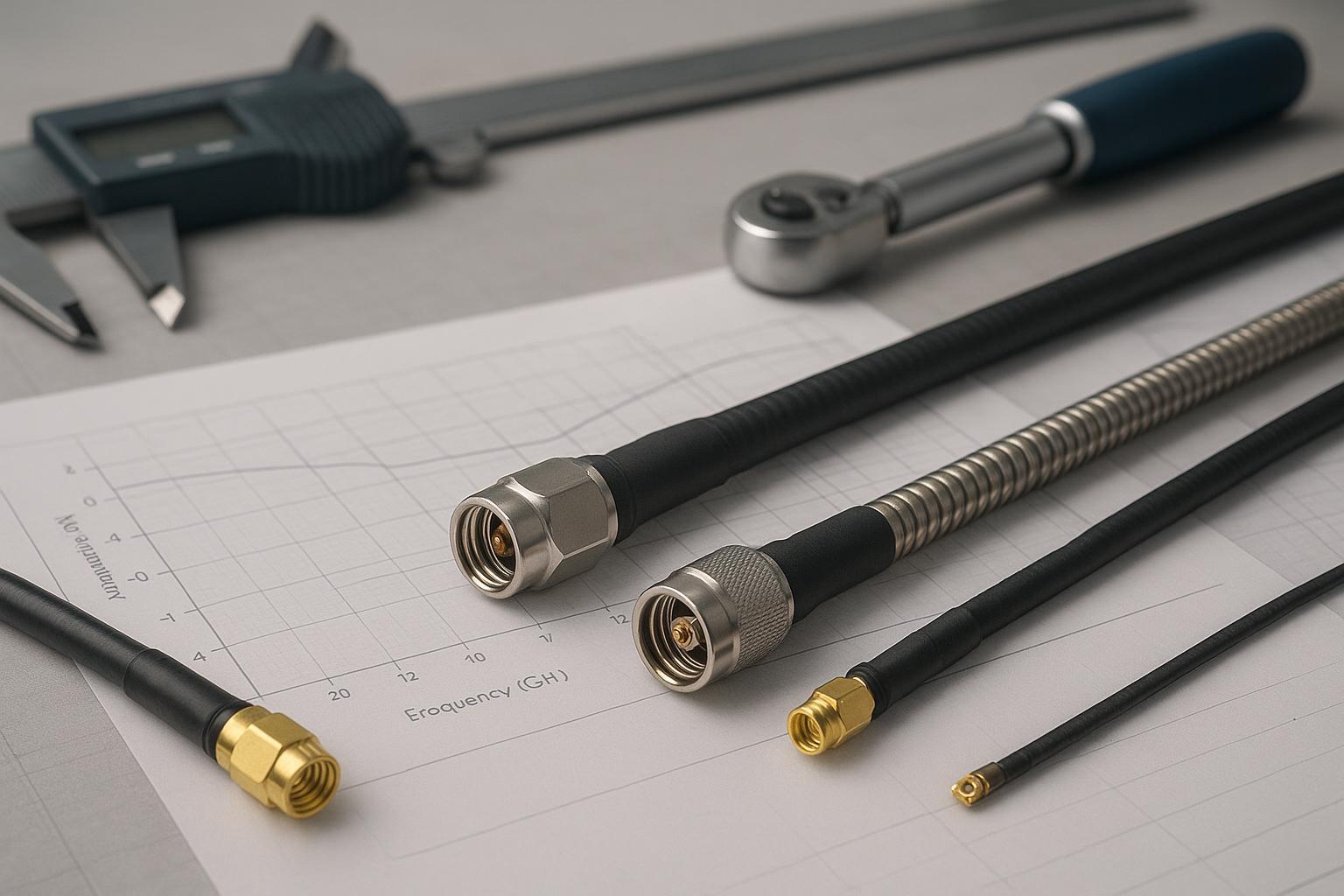
If you’re buying for RF systems, RF coaxial cables quietly determine link budget, uptime, and total cost of ownership. The right line size and connectorization keep VSWR low, trim losses at your highest operating frequency, and stand up to the environment your project lives in. This guide translates engineering requirements into purchasing criteria you can use in RFQs and vendor reviews—so your RF coaxial cables deliver predictable performance throughout their lifecycle.
Key takeaways
●Start with frequency and run length, then size attenuation; verify power handling, impedance, connector interfaces, and environment before you issue an RFQ.
●Use datasheet attenuation at your top frequency to pick between families (e.g., LMR vs RG) and diameters; don’t rely on single-point “typical” figures.
●Maintenance discipline (cleaning, torque, bend radius, sealing) prevents avoidable VSWR spikes and downtime; set inspection and test expectations in contracts.
The quick primer on RF coaxial cables
Most buying decisions cluster around four families. Think of them as lanes on a highway: flexible RG for general traffic, low‑loss LMR for longer, faster lanes, semi‑rigid/formable for precision exits inside equipment, and corrugated hardline for the heavy trucks of infrastructure.
RG flexible lines are the classic general‑purpose series spanning 50 Ω (e.g., RG‑58, RG‑213) and 75 Ω (e.g., RG‑6, RG‑59) used in test leads, radio, and video. Loss varies widely by type and maker, so always compare like‑for‑like datasheets.
LMR low‑loss flexible cables are modern, well‑documented lines with accessories across sizes like LMR‑240 and LMR‑400. Times Microwave’s family guides outline construction and performance across variants such as FR, UF, and DB for different environments, with consistent attenuation tables by frequency in the datasheets. See the manufacturer’s overview in the LMR complete guide (Times Microwave, 2024).
Semi‑rigid and formable cables deliver precise, stable phase for internal interconnects; they offer excellent repeatability but limited flexibility.
Corrugated hardline serves infrastructure feeders for very long runs and high power; it offers extremely low loss but larger bend radii and specialized connectors.
Two system traits steer early choices for RF coaxial cables:
●50 Ω vs 75 Ω: Most radio and data links are 50 Ω; broadcast/video and CATV are 75 Ω. Mixing them raises reflections unless you add matching pads or adapters. For an approachable overview of use cases, see Fairview Microwave’s basics of BNC connectors.
●Connector landscape: Expect SMA and N for 50 Ω RF; TNC in ruggedized runs; BNC for lab/video; MCX/MMCX in compact gear; miniature IPEX/U.FL on modules.
Mini comparison at 1 GHz (typical values per datasheet):
Cable | Attenuation at 1 GHz (dB/100 ft) | Primary source |
|---|---|---|
LMR‑240 | 9.9 | |
LMR‑400 | 5.1 |
Those figures help you sanity‑check run lengths: for the same frequency and length, the larger‑diameter LMR‑400 loses roughly half the power that LMR‑240 does.
A procurement selection framework for RF coaxial cables
Here’s a simple way to reach a defensible choice without getting lost in equations.
1.Frequency and run length → attenuation budget
●Identify your highest operating frequency and the maximum acceptable path loss across the cable. Use datasheet attenuation at that frequency, scaled to your planned length, to shortlist families and diameters. If you’re on the fence between two sizes, check the next frequency octave, too.
2.Power handling and dielectric
●Confirm continuous‑wave and peak power ratings at your frequency. Higher frequency raises dielectric loss and heating; keep a margin if ambient temperatures are high or runs are bundled.
3.Impedance match and adapters
●Keep the system consistent (50 Ω or 75 Ω) end‑to‑end. If you must mix, insert proper matching pads; otherwise, expect degraded return loss.
4.Shielding, PIM expectations, and test method
●Specify shielding construction (foil plus braid for wideband shielding) and, if you’re in cellular or other sensitive services, ask for passive intermodulation test results using the IEC 62037 method family. The standard defines the two‑tone measurement approach; acceptance levels are set by your application and vendor spec. See IEC 62037 series overview (IEC Webstore) for scope and method references.
5.Environment, jacket, and compliance
●Outdoor runs benefit from UV‑resistant PE jackets; indoor plenum/vertical shafts may dictate FR or LSZH variants. Call out temperature range, UV, and safety listings (UL/CSA/CPR) in the RFQ.
6.Connectors and assembly quality
●Name the interfaces (e.g., SMA to N) and materials. Assembly workmanship matters: proper crimp/solder, strain relief, and torque. As a reference point, Amphenol RF lists SMA plug mating torque ranges depending on materials; verify the exact value on your connector’s datasheet. See Amphenol RF on SMA connectors for guidance.
7.Vendor documentation
●Require current datasheets with attenuation tables, bend radii (installation vs repeated), power handling, temperature range, test results (VSWR and PIM if relevant), and compliance statements (RoHS/REACH and safety listings).
Suggested RFQ boilerplate you can adapt:
Cable assembly requirements
- System: 50 Ω (or 75 Ω), operate to [max frequency] GHz.
- Run length: [L] m/ft; max total cable loss ≤ [X] dB at [max frequency] GHz.
- Cable family/size: [preferred family/size], alternatives allowed if loss and bend radius meet targets.
- Connectors: [interface/material/plating] at source → [interface/material/plating] at load; include recommended mating torque in datasheet.
- Environment: [indoor/outdoor], jacket [PE/FR/LSZH], operating temp [min..max] °C, UV rating [if outdoor].
- Tests: Provide VSWR sweep to [max frequency] GHz; if applicable, PIM per IEC 62037 with stated conditions and acceptance level.
- Documentation: Attenuation table; min bend radius (install/repeated); power handling at [freq]; compliance (RoHS/REACH, UL/CSA/CPR as applicable).
The specs that matter and how to read them
Attenuation and sizing
●Use the manufacturer’s attenuation at your top frequency, scaled to length, to choose a diameter. For example, per Times Microwave datasheets, LMR‑240 is 9.9 dB/100 ft at 1 GHz and LMR‑400 is 5.1 dB/100 ft at 1 GHz. That difference can make or break a tight link budget. Check the actual PDFs: LMR‑240 datasheet and LMR‑400 datasheet.
Power handling and heat
●Power ratings fall with frequency as dielectric loss rises. Stay conservative if you expect high ambient temperatures or bundling. When in doubt, ask the vendor for derating curves or a worst‑case figure at your frequency.
Impedance and return loss
●Keep 50 Ω or 75 Ω consistently across cable and connectors. If you must join worlds, a matching pad prevents hard reflections. For a clear, vendor‑neutral explainer of where each impedance is common, see Fairview Microwave’s BNC connector basics.
Shielding effectiveness and PIM
●Foil‑plus‑braid constructions improve wideband shielding and help keep coupled noise down. In cellular and other sensitive systems, specify low‑PIM assemblies and request test data using the IEC 62037 methodology; acceptable levels vary by application and must be stated in the RFQ and vendor response.
Bend radius
●Datasheets often distinguish “installation” versus “repeated” bend radius. For instance, Times Microwave lists LMR‑240 at 0.75 in (install) and 2.5 in (repeated), and LMR‑400 at 1.0 in (install) and 4.0 in (repeated). Those values come directly from the manufacturer PDFs cited above; route accordingly and call these limits out in drawings.
Connectors and torque
●Under‑ or over‑torqueing is a common cause of intermittent VSWR. As a benchmark, SMA interfaces typically specify mating torque within narrow ranges that depend on materials; confirm on the connector datasheet. Amphenol RF’s SMA page provides representative ranges and handling guidance.
Maintenance SOPs to keep VSWR low
You’ll save money and outages by setting handling expectations in purchase orders and maintenance contracts. Here’s a practical baseline you can tailor with your vendors and O&M partners.
Cleaning and contact care Keep mating planes and threads clean; remove metallic particles after any cable cutting before connectorization. Keysight explains good hygiene for cable and antenna measurements in an application note; see Keysight’s measurement hygiene guidance. Cleanliness is one of the fastest ways to keep RF coaxial cables performing to spec.
Torque and strain relief Use preset torque wrenches for threaded connectors; add strain relief to avoid torsion at the back shell. A concise field‑focused read on common pitfalls is Kinghelm’s 7 common SMA connector mistakes.
Bend radius and routing Respect both installation and repeated‑bend minima (the LMR‑240/400 figures above illustrate why). Avoid tight service loops that creep below the repeated radius. Over‑bending RF coaxial cables invites micro‑kinks and impedance discontinuities that show up as VSWR spikes later.
Weatherproofing and sealing Outdoor joints need boots or tape kits and UV‑resistant jackets; re‑inspect after seasonal extremes. Call for resealing after connector maintenance.
Inspection and test cadence As a policy default, do quarterly visual checks on outdoor runs and an annual sweep test to the system’s top frequency. Treat this as a starting point and adjust based on environment and vendor O&M guidance.
Practical scenarios and one neutral example
Scenario 1 — Indoor Wi‑Fi module to panel antenna
●Requirement: 2.4/5 GHz, 1.5 m run inside an enclosure with occasional servicing. Loss target ≤1.5 dB at 5 GHz. Interfaces: IPEX/U.FL at the module, SMA bulkhead at the panel.
●selection: Favor a 50 Ω low‑loss flexible line such as an LMR‑200/240‑class jumper over micro‑coax if routing space allows; specify FR jacket if the enclosure demands it. Call out SMA mating torque and the repeated bend radius for the chosen cable in the RFQ. Vendors such as Kinghelm offer IPEX↔SMA jumpers and related connectors you can evaluate against these criteria.
Scenario 2 — Rooftop cellular repeater feed
●Requirement: Several tens of meters outdoors; high duty cycle near band tops. Loss and PIM sensitivity dominate.
●selection: Step up in diameter (e.g., LMR‑400‑class or corrugated hardline) to control attenuation; require UV‑resistant jackets, low‑PIM test data per IEC 62037, and weatherproofed connectors.
Scenario 3 — Indoor DAS jumper
●Requirement: Short, flexible jumpers with repeatable performance.
●selection: Prefer flexible low‑loss jumpers with documented repeated bend radii; specify connector torque ranges and periodic replacement after a defined cycle count.
Next steps
●Convert system limits into procurement criteria: top frequency, acceptable cable loss, environment, connector interfaces, and any PIM expectations.
●Use the RFQ snippet above and insist on datasheets with attenuation tables, bend radii, and torque guidance.
●If you need a starting point for off‑the‑shelf assemblies and connectors to benchmark, browse Kinghelm’s products overview and compare options using the checklist you’ve built. Along the way, keep repeating the simple rule: size RF coaxial cables by frequency and length first, then confirm the rest.
RF Coaxial Cables Explained: Types, Uses, and Maintenance
If you’re buying for RF systems, RF coaxial cables quietly determine link budget, uptime, and total cost of ownership. The right line size and connectorization keep VSWR low, trim losses at your highest operating frequency, and stand up to the environment your project lives in. This guide translates engineering requirements into purchasing criteria you can use in RFQs and vendor reviews—so your RF coaxial cables deliver predictable performance throughout their lifecycle.
Key takeaways
Start with frequency and run length, then size attenuation; verify power handling, impedance, connector interfaces, and environment before you issue an RFQ.
Use datasheet attenuation at your top frequency to pick between families (e.g., LMR vs RG) and diameters; don’t rely on single-point “typical” figures.
Maintenance discipline (cleaning, torque, bend radius, sealing) prevents avoidable VSWR spikes and downtime; set inspection and test expectations in contracts.
The quick primer on RF coaxial cables
Most buying decisions cluster around four families. Think of them as lanes on a highway: flexible RG for general traffic, low‑loss LMR for longer, faster lanes, semi‑rigid/formable for precision exits inside equipment, and corrugated hardline for the heavy trucks of infrastructure.
RG flexible lines are the classic general‑purpose series spanning 50 Ω (e.g., RG‑58, RG‑213) and 75 Ω (e.g., RG‑6, RG‑59) used in test leads, radio, and video. Loss varies widely by type and maker, so always compare like‑for‑like datasheets.
LMR low‑loss flexible cables are modern, well‑documented lines with accessories across sizes like LMR‑240 and LMR‑400. Times Microwave’s family guides outline construction and performance across variants such as FR, UF, and DB for different environments, with consistent attenuation tables by frequency in the datasheets. See the manufacturer’s overview in the LMR complete guide (Times Microwave, 2024).
Semi‑rigid and formable cables deliver precise, stable phase for internal interconnects; they offer excellent repeatability but limited flexibility.
Corrugated hardline serves infrastructure feeders for very long runs and high power; it offers extremely low loss but larger bend radii and specialized connectors.
Two system traits steer early choices for RF coaxial cables:
50 Ω vs 75 Ω: Most radio and data links are 50 Ω; broadcast/video and CATV are 75 Ω. Mixing them raises reflections unless you add matching pads or adapters. For an approachable overview of use cases, see Fairview Microwave’s basics of BNC connectors.
Connector landscape: Expect SMA and N for 50 Ω RF; TNC in ruggedized runs; BNC for lab/video; MCX/MMCX in compact gear; miniature IPEX/U.FL on modules.
Mini comparison at 1 GHz (typical values per datasheet):
Cable | Attenuation at 1 GHz (dB/100 ft) | Primary source |
|---|---|---|
LMR‑240 | 9.9 | |
LMR‑400 | 5.1 |
Those figures help you sanity‑check run lengths: for the same frequency and length, the larger‑diameter LMR‑400 loses roughly half the power that LMR‑240 does.
A procurement selection framework for RF coaxial cables
Here’s a simple way to reach a defensible choice without getting lost in equations.
Frequency and run length → attenuation budget
Identify your highest operating frequency and the maximum acceptable path loss across the cable. Use datasheet attenuation at that frequency, scaled to your planned length, to shortlist families and diameters. If you’re on the fence between two sizes, check the next frequency octave, too.
Power handling and dielectric
Confirm continuous‑wave and peak power ratings at your frequency. Higher frequency raises dielectric loss and heating; keep a margin if ambient temperatures are high or runs are bundled.
Impedance match and adapters
Keep the system consistent (50 Ω or 75 Ω) end‑to‑end. If you must mix, insert proper matching pads; otherwise, expect degraded return loss.
Shielding, PIM expectations, and test method
Specify shielding construction (foil plus braid for wideband shielding) and, if you’re in cellular or other sensitive services, ask for passive intermodulation test results using the IEC 62037 method family. The standard defines the two‑tone measurement approach; acceptance levels are set by your application and vendor spec. See IEC 62037 series overview (IEC Webstore) for scope and method references.
Environment, jacket, and compliance
Outdoor runs benefit from UV‑resistant PE jackets; indoor plenum/vertical shafts may dictate FR or LSZH variants. Call out temperature range, UV, and safety listings (UL/CSA/CPR) in the RFQ.
Connectors and assembly quality
Name the interfaces (e.g., SMA to N) and materials. Assembly workmanship matters: proper crimp/solder, strain relief, and torque. As a reference point, Amphenol RF lists SMA plug mating torque ranges depending on materials; verify the exact value on your connector’s datasheet. See Amphenol RF on SMA connectors for guidance.
Vendor documentation
Require current datasheets with attenuation tables, bend radii (installation vs repeated), power handling, temperature range, test results (VSWR and PIM if relevant), and compliance statements (RoHS/REACH and safety listings).
Suggested RFQ boilerplate you can adapt:
Cable assembly requirements
- System: 50 Ω (or 75 Ω), operate to [max frequency] GHz.
- Run length: [L] m/ft; max total cable loss ≤ [X] dB at [max frequency] GHz.
- Cable family/size: [preferred family/size], alternatives allowed if loss and bend radius meet targets.
- Connectors: [interface/material/plating] at source → [interface/material/plating] at load; include recommended mating torque in datasheet.
- Environment: [indoor/outdoor], jacket [PE/FR/LSZH], operating temp [min..max] °C, UV rating [if outdoor].
- Tests: Provide VSWR sweep to [max frequency] GHz; if applicable, PIM per IEC 62037 with stated conditions and acceptance level.
- Documentation: Attenuation table; min bend radius (install/repeated); power handling at [freq]; compliance (RoHS/REACH, UL/CSA/CPR as applicable).
The specs that matter and how to read them
Attenuation and sizing
Use the manufacturer’s attenuation at your top frequency, scaled to length, to choose a diameter. For example, per Times Microwave datasheets, LMR‑240 is 9.9 dB/100 ft at 1 GHz and LMR‑400 is 5.1 dB/100 ft at 1 GHz. That difference can make or break a tight link budget. Check the actual PDFs: LMR‑240 datasheet and LMR‑400 datasheet.
Power handling and heat
Power ratings fall with frequency as dielectric loss rises. Stay conservative if you expect high ambient temperatures or bundling. When in doubt, ask the vendor for derating curves or a worst‑case figure at your frequency.
Impedance and return loss
Keep 50 Ω or 75 Ω consistently across cable and connectors. If you must join worlds, a matching pad prevents hard reflections. For a clear, vendor‑neutral explainer of where each impedance is common, see Fairview Microwave’s BNC connector basics.
Shielding effectiveness and PIM
Foil‑plus‑braid constructions improve wideband shielding and help keep coupled noise down. In cellular and other sensitive systems, specify low‑PIM assemblies and request test data using the IEC 62037 methodology; acceptable levels vary by application and must be stated in the RFQ and vendor response.
Bend radius
Datasheets often distinguish “installation” versus “repeated” bend radius. For instance, Times Microwave lists LMR‑240 at 0.75 in (install) and 2.5 in (repeated), and LMR‑400 at 1.0 in (install) and 4.0 in (repeated). Those values come directly from the manufacturer PDFs cited above; route accordingly and call these limits out in drawings.
Connectors and torque
Under‑ or over‑torqueing is a common cause of intermittent VSWR. As a benchmark, SMA interfaces typically specify mating torque within narrow ranges that depend on materials; confirm on the connector datasheet. Amphenol RF’s SMA page provides representative ranges and handling guidance.
Maintenance SOPs to keep VSWR low
You’ll save money and outages by setting handling expectations in purchase orders and maintenance contracts. Here’s a practical baseline you can tailor with your vendors and O&M partners.
Cleaning and contact care Keep mating planes and threads clean; remove metallic particles after any cable cutting before connectorization. Keysight explains good hygiene for cable and antenna measurements in an application note; see Keysight’s measurement hygiene guidance. Cleanliness is one of the fastest ways to keep RF coaxial cables performing to spec.
Torque and strain relief Use preset torque wrenches for threaded connectors; add strain relief to avoid torsion at the back shell. A concise field‑focused read on common pitfalls is Kinghelm’s 7 common SMA connector mistakes.
Bend radius and routing Respect both installation and repeated‑bend minima (the LMR‑240/400 figures above illustrate why). Avoid tight service loops that creep below the repeated radius. Over‑bending RF coaxial cables invites micro‑kinks and impedance discontinuities that show up as VSWR spikes later.
Weatherproofing and sealing Outdoor joints need boots or tape kits and UV‑resistant jackets; re‑inspect after seasonal extremes. Call for resealing after connector maintenance.
Inspection and test cadence As a policy default, do quarterly visual checks on outdoor runs and an annual sweep test to the system’s top frequency. Treat this as a starting point and adjust based on environment and vendor O&M guidance.
Practical scenarios and one neutral example
Scenario 1 — Indoor Wi‑Fi module to panel antenna
Requirement: 2.4/5 GHz, 1.5 m run inside an enclosure with occasional servicing. Loss target ≤1.5 dB at 5 GHz. Interfaces: IPEX/U.FL at the module, SMA bulkhead at the panel.
Selection: Favor a 50 Ω low‑loss flexible line such as an LMR‑200/240‑class jumper over micro‑coax if routing space allows; specify FR jacket if the enclosure demands it. Call out SMA mating torque and the repeated bend radius for the chosen cable in the RFQ. Vendors such as Kinghelm offer IPEX↔SMA jumpers and related connectors you can evaluate against these criteria.
Scenario 2 — Rooftop cellular repeater feed
Requirement: Several tens of meters outdoors; high duty cycle near band tops. Loss and PIM sensitivity dominate.
Selection: Step up in diameter (e.g., LMR‑400‑class or corrugated hardline) to control attenuation; require UV‑resistant jackets, low‑PIM test data per IEC 62037, and weatherproofed connectors.
Scenario 3 — Indoor DAS jumper
Requirement: Short, flexible jumpers with repeatable performance.
Selection: Prefer flexible low‑loss jumpers with documented repeated bend radii; specify connector torque ranges and periodic replacement after a defined cycle count.
Next steps
Convert system limits into procurement criteria: top frequency, acceptable cable loss, environment, connector interfaces, and any PIM expectations.
Use the RFQ snippet above and insist on datasheets with attenuation tables, bend radii, and torque guidance.
If you need a starting point for off‑the‑shelf assemblies and connectors to benchmark, browse Kinghelm’s products overview and compare options using the checklist you’ve built. Along the way, keep repeating the simple rule: size RF coaxial cables by frequency and length first, then confirm the rest.


Comments
Post a Comment